Method article
The Product Experience Blueprint
Connecting human-systems evidence to product definition and AI-assisted delivery
Chris Durgin · Version 1.6 · Updated · About 14 min for the main article
Original article text: CC BY 4.0 · Reuse and attribution
Abstract
The Product Experience Blueprint (PEB) is a method I developed to bridge discovery and delivery. It translates research, observations, subject-matter expertise, and operating context into shared product intent: who the product serves, what it must achieve, and what to build first. The blueprint connects that intent to workflows, capabilities, requirements, data needs, MVP scope, and validation. This article explains the method, its use with AI-assisted builds and Agile teams, and applications from my practice. These accounts offer practical lessons rather than a controlled evaluation of the method.
The problem: evidence without a shared product direction
Product teams can have research, requirements, workflow maps, and technical guidance yet still disagree about what to build. The missing piece is often a shared explanation of how the evidence should shape the product.
AI-assisted delivery makes shared direction especially consequential: an assistant can build from instructions that leave user needs, scope, or data support unresolved. The PEB brings those decisions into review before and during implementation.
From discovery to buildable product intent
A PEB connects what teams learned, what the product must achieve, and what should be built first. I use it as a shared source of product intent for designers, researchers, engineers, delivery teams, and AI tools. It carries the reasoning from discovery into requirements that people and agents can act on, then records what the team needs to learn from the resulting product.
The blueprint preserves discovery and product judgment through the build process. Research repositories, workflow records, and technical specifications remain authoritative in their own domains; the PEB references them and makes the resulting product decisions explicit. Its opening links vision, problem, primary job, and hypothesis, while the detailed sections connect those ideas to scope, requirements, and validation.
The approach builds on human-centered design, workflow analysis, requirements definition, and prototyping. ISO 9241-210 provides broader human-centred design guidance, while NASA’s Systems Engineering Handbook describes requirements traceability and validation practices. These are foundations for the discussion, rather than evaluations of PEB.
Six connected areas of product definition
- Opportunity and value. Why does this matter? Define the problem and intended user, business, and operational outcomes.
- Users and context. Who does it serve, and under what conditions? Describe roles, environments, constraints, access needs, and moments of use.
- Workflows and decisions. How does the work happen? Connect tasks, handoffs, decision authority, information needs, and failure points.
- Experience and capabilities. How should the product support the work? Define principles, interactions, and capabilities that enable the intended outcomes.
- Requirements and data. What must work for the experience to be useful? Connect functional, UX, information, and data requirements to constraints, dependencies, and feasibility.
- MVP and validation. What should be built first, and what would justify refining or expanding it? Establish scope, deferrals, learning goals, and observable success criteria.
Trace each consequential product decision to evidence, or mark it as an assumption, gap, risk, or validation need. This keeps requirements connected to their rationale and gives the team a way to revise them when new evidence emerges.
When to use a PEB
Use a PEB when product, research, design, data, and engineering teams have pieces of the context but lack a shared account of what to build and why. It is especially useful before a prototype, an AI-assisted build, or a cross-functional delivery handoff. Start small for a focused change; a simple task does not need a large document.
A product requirements document can describe expected capabilities and behavior. A service blueprint can map the wider service, including people, touchpoints, and supporting processes. A backlog organizes delivery work. PEB complements these artifacts by connecting the relevant evidence to product decisions, scope, feasibility, and validation. Teams can keep those connections inside an existing document system rather than create duplicate sources of truth.
Working through a blueprint
- Frame the opportunity. State the problem, intended value, users, operating context, and desired outcomes. Separate observed needs from stakeholder requests and hypotheses.
- Connect people and work. Identify roles, goals, workflow moments, handoffs, decision authority, and information needs. Reference the supporting research and identify gaps.
- Define the experience. Translate those needs into capabilities, experience principles, information hierarchy, navigation, interactions, and recovery behavior. Explain the reasoning behind key choices.
- Bound the minimum viable product (MVP). State what belongs in the first iteration, what is deferred, and what is excluded. Check data availability, source ownership, freshness, and feasibility against the intended experience.
- Guide the build. Give implementers and AI tools a coherent account of intended behavior. Link to design-system rules and reusable agent instructions rather than duplicating them.
- Validate and revise. Identify the questions a prototype must answer. Review workflow fit, comprehension, decision support, trust, and unsupported assumptions. Record what changed and why.
The minimum useful blueprint
For a focused change, begin with six fields. A short, reviewable chain is enough to start.
- Person and decision: who needs to decide or do what?
- Evidence: what observation supports the need, and what remains assumed?
- Capability: what behavior would help, including missing-data and recovery paths?
- Scope and dependencies: what is included, excluded, or blocked?
- Validation: what task or observation would support or challenge the proposal?
- Owner and revision: who resolves the next question, and how will the result change the plan?
Expand into the full template when multiple roles, data sources, permissions, risks, or delivery teams require more explicit coordination. Keep supporting records linked rather than copying them into every section.
One decision, traced through a blueprint
This fictional maintenance-planning example shows the connections I expect a blueprint to preserve. Follow the same scenario in the completed blueprint below, where source notes connect to requirements, scope, and validation.
- Need
- A planner needs to prepare a feasible shift plan. The example’s planning-workshop note (S1) describes separate work-order and parts records.
- Decision
- Which proposed jobs need clarification before they can enter the plan?
- Capability
- Show each job’s blocker, responsible role, and supporting record.
- Information needed
- A sample export supplies work-order fields (S4), but no parts feed is supplied. Live sources, meanings, and fitness for planning still require review.
- Acceptance criterion
- When a required source is missing, show “Readiness unconfirmed,” identify the gap, and avoid presenting the job as ready.
- Validation
- Ask planners to distinguish a blocked job from one whose readiness is unknown, explain the evidence, and identify the next owner.
- Revision rule
- If those states are confused, revise their labels and explanations, update the acceptance criterion, and repeat the task. Record the observation, change, and retest result in the iteration history.
Using the PEB with AI
When user, workflow, requirement, or success criteria are missing from the supplied context, an AI tool must infer them or ask for clarification. That can yield plausible screens built around assumptions the team has not examined. A PEB grounds implementation in reviewed product intent, with prioritized capabilities, evidence, dependencies, and explicit unknowns.
The working path is discovery and evidence → blueprint → AI-assisted or team-led implementation → working prototype → field validation → revised blueprint and product. Keep research findings, data-availability records, design-system guidance, and agent instructions connected to that path. With sufficient detail and supporting references, a full PEB can guide an end-to-end build; resolve missing business rules and integrations explicitly.
The aim is a relevant, traceable, testable implementation that the team can refine. Humans supply and assess the evidence, approve requirements, and remain accountable for product decisions. Review generated behavior against the blueprint, then use validation findings to update both the product and its rationale.
From blueprint to an Agile delivery backlog
The PEB also supports traditional Agile development teams. In my practice, I use the blueprint with the Human-Systems Engineering Agent (HSE Agent), my toolkit of reusable instructions for AI assistants, to prepare an end-to-end backlog for team review. The blueprint supplies the users, intended value, workflows, scope, constraints, and validation needs.
The backlog skill helps organize that context into epics, features, and smaller stories. Each item should preserve the user need, reference the relevant blueprint decision, and describe observable acceptance criteria. Carry dependencies and open questions forward; use discovery work where a requirement is not yet supported. Include data, integrations, permissions, accessibility, recovery, and operational handoffs wherever the workflow requires them.
For example, the maintenance-planning scenario introduced above could lead to a story for inspecting a job’s blocker, responsible role, and supporting record. When the supporting source is missing, the acceptance criteria require “Readiness unconfirmed” and an explanation of the gap. That keeps the implementation connected to the decision the planner needs to make.
The team reviews workflow coverage, splits useful increments, and agrees priorities, estimates, and technical feasibility. As delivery and research change the direction, update the blueprint and linked backlog together. The HSE Agent article explains how the skills support these handoffs.
Development through practice
I developed PEB to connect research, operational decisions, data constraints, and implementation in my product work. An early application at Freeport-McMoRan (FMI) was Reliability Engineering (RE) Workbench, a decision-support workspace for engineers and planners. Its blueprint connected a prioritized asset queue to supporting signals, investigation, recommended actions, and a handoff to the operational system.
The blueprint also defined validation questions: could users explain why an asset was prioritized and recognize missing evidence? Those questions helped establish what the prototype needed to demonstrate. Within one week, we moved from research workshops through the blueprint to a testable MVP prototype, with most of that time devoted to research and workshops.
In a demonstration to RE stakeholders and subject-matter experts, the group praised the turnaround, prioritization queue, and supporting Failure Mode Signal Correlation Model, which defined asset-health and prioritization scores. They valued the investigation path from an initial signal to the contributing factors behind an asset’s condition.
The blueprint gave us a shared reference for product intent, scope, and decision logic as we moved from research into prototyping. As field testing informed later iterations, I updated the blueprint and used those revisions to guide changes to the prototype.
The next three practice examples show how I used PEB at FMI to guide a production enhancement, refine a prototype, and identify data-feasibility gaps.
Annual Goals: from product definition to production
OpsHub Annual Goals helps users review progress against annual operational goals. It is live on FMI’s Enterprise Workspace (EWS) platform, with regular use and positive user feedback from my practice.
The second-iteration blueprint defines a focused enhancement for reviewing unplanned equipment downtime. It preserves the earlier wireframe and established navigation while making the path from overall progress to equipment-class and site detail more explicit. It records stakeholder feedback that the existing structure and visual hierarchy were working well.
The blueprint also makes a calculation dependency visible: combining equipment-class results requires agreed weights. It prohibits inventing those weights or presenting an unofficial combined result as final, and defines an interim display while the calculation remains unresolved. This illustrates how a blueprint can guide useful behavior before every dependency is settled.
The lesson is to preserve what is working, isolate the next decision problem, and make unsettled calculations explicit.
Case at a glance
- Observed issue
- The next iteration needed clearer downtime detail while preserving a structure stakeholders found useful.
- Design response
- Define the drill-down and make unresolved calculation weights explicit.
- Outcome and limits
- The existing product is in regular production use with positive qualitative feedback. These observations do not establish that the proposed second-iteration features have shipped.
Helena: building and refining a non-AI product
Helena’s Upload Repository is a proposed workspace for managing the data files that feed an operational application. I supplied its PEB to an AI assistant to build a prototype in Flutter, a framework for application development. The prototype supported comma-separated value (CSV) file upload, validation, retrieval, replacement, archive, and restore workflows. The blueprint distinguished recoverable plan replacement from permanent replacement of files containing actual operational results, and specified permissions, failure states, and validation tasks.
This was an AI-assisted development process for a product with no AI features in scope. The blueprint guided behavior and review, while a separate design-system skill guided component construction. File transfer and backend ingestion were simulated, with repository state held in memory.
During workflow quality assurance (QA) and prototype review, feedback changed mobile action placement, role selection, control sizing, terminology, filter spacing, and table-scroll visibility.
The core workflows remained stable, while review exposed responsive behavior that the original blueprint had left open. At this stage, those changes were implemented in the prototype and proposed for the blueprint. The lesson is to carry implementation learning back into product guidance so the prototype does not become the only record of the decisions.
Case at a glance
- Observed issue
- Prototype review exposed unspecified responsive behavior and crowded controls.
- Design response
- Refine mobile actions, role selection, spacing, naming, and table scrolling.
- Outcome and limits
- Changes were implemented in a simulated prototype. Participant outcomes and production ingestion were not established.
Connected Ops: a decision filter with a confidence gap
In Connected Ops Crew Performance, the supervisor’s job was to review shift results, identify an underperforming crew, and take action. The blueprint connected that job to decision signals. Comparing those signals with a data-availability matrix helped distinguish what could be built immediately, derived next, or investigated further.
This shifted the discussion from counting available fields to considering blocked decisions. A missing source that prevented an entire section from supporting its purpose mattered more than an optional control. MVP boundaries also kept predictive and automated features outside the prototype.
The work also exposed problems in the blueprint and build. Data readiness had been overstated; the prototype used other sites’ data instead of the intended site; some metrics were approximations; and an embedded snapshot was labeled as live. These issues limited what the prototype could demonstrate.
That experience supports a specific refinement to PEB: each signal needs a definition, target population, source evidence, freshness, derivation, validation status, and an explanation of which decision is blocked if it is missing. Proxies and unvalidated calculations need visible labels. An interaction prototype can demonstrate a proposed experience while leaving operational data feasibility unresolved.
My account is retrospective, and supervisor validation remained planned. The lesson is to inspect the blueprint’s assumptions as carefully as the interface it guides.
Case at a glance
- Observed issue
- A workable screen depended on data availability and metric definitions that were not fully established.
- Design response
- Use the blueprint to rank decision-blocking gaps and identify assumptions requiring validation.
- Outcome and limits
- The prototype demonstrated an interaction pattern using other-site data and approximations. Target-site data feasibility and supervisor validation remained unresolved.
What the applications suggest
Across these applications, the value of PEB came from keeping product intent connected to decisions and their rationale. RE Workbench shows the progression from research and product definition to a prototype the stakeholder group could review. Annual Goals illustrates preserving an established experience while defining the next enhancement. Helena shows how prototype review reveals interaction requirements. Connected Ops shows why data-readiness claims need supporting evidence.
Keep an iteration record linking each important observation to a proposed change, its rationale, affected requirements, and the next validation step. Feed implementation learning back into the blueprint so the prototype does not become the only record of the decisions.
Evidence, limitations, and evaluation
These are selected practice accounts based on internal project artifacts and my experience, rather than comparative studies. The internal records are not reproduced here. They illustrate how I used PEB and the problems it exposed, but do not isolate its effect on delivery speed, decision quality, or adoption.
A useful evaluation would examine whether teams can trace requirements to evidence, whether implementers interpret scope consistently, and whether users can make the intended decisions. It should also assess the effort required to maintain the blueprint and consider other factors affecting the results.
A blueprint depends on the quality of its inputs and ongoing review. Use research, data validation, and specialist assessment to test the assumptions it makes visible.
Check your blueprint before review
Before sharing a blueprint, check that each core capability connects to a user need or decision, important assumptions have a responsible reviewer, data gaps have explicit scope consequences, and the team knows what to validate next. Include the main workflow’s handoffs, failure paths, and recovery behavior.
Ask a colleague to trace one user need through the proposed capability, source evidence, build requirement, and validation task. Revise any unclear connection. A useful review can proceed with unresolved questions when their implications and next steps are visible.
Try it in practice
Choose one important user decision and use the six-field starter to describe it. Bring that short chain to a colleague from research, product, design, or engineering. Use the first unresolved question to choose the next observation, prototype, or data check; expand the blueprint as the work requires.
Template and completed example
Use the blank template to start your own blueprint, or study the completed maintenance-planning example to see how vision, hypotheses, decisions, and validation connect.
Completed blueprint
Maintenance planning workspace
Fictional maintenance-planning scenario · Version 1.0
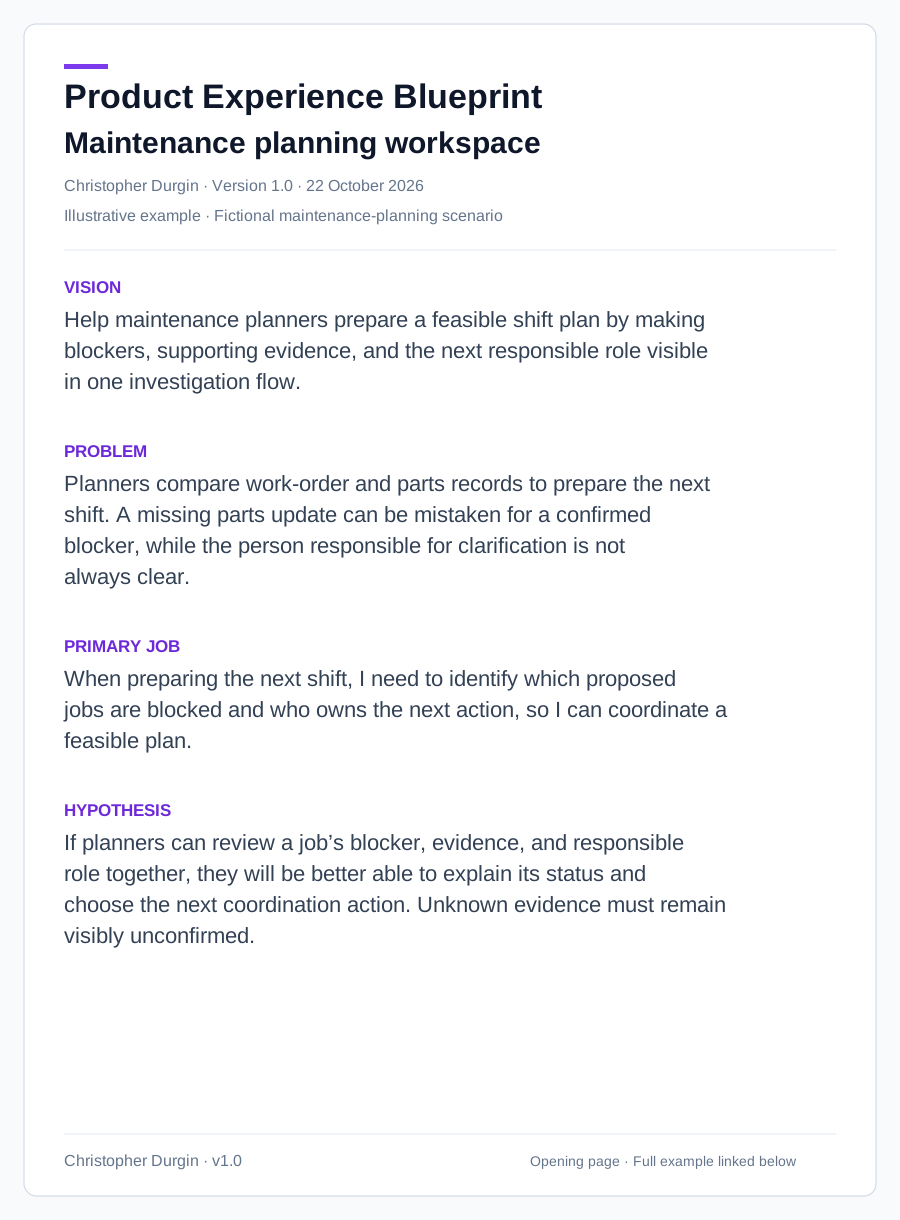
The completed document follows the template from vision and primary job through scope, data confidence, acceptance criteria, and planned validation. An illustrative revision shows how feedback would change both the blueprint and prototype.
Licensed under CC BY 4.0. Share and adapt with credit to Christopher Durgin; include the license link and indicate any changes.
Read the opening-page text
- Vision
- Help maintenance planners prepare a feasible shift plan by making blockers, supporting evidence, and the next responsible role visible in one investigation flow.
- Problem
- Planners compare work-order and parts records to prepare the next shift. A missing parts update can be mistaken for a confirmed blocker, while the person responsible for clarification is not always clear.
- Primary job
- When preparing the next shift, I need to identify which proposed jobs are blocked and who owns the next action, so I can coordinate a feasible plan.
- Hypothesis
- If planners can review a job’s blocker, evidence, and responsible role together, they will be better able to explain its status and choose the next coordination action. Unknown evidence must remain visibly unconfirmed.
- Step 1: Need
- Step 2: Decision
- Step 3: Capability
- Step 4: Evidence
- Step 5: Scope
- Step 6: Validation
- Step 7: Revision
Explore the decision-chain annotations
1. Start with the work
A maintenance planner prepares the next shift’s work. Hypothesis: bringing work-order status and parts blockers together will make readiness easier to assess.
Why this matters: The example’s source notes explain the problem framing. In practice, link these statements to your own research records.
2. Name the decision
When preparing the next shift, I need to identify which proposed jobs are blocked and who owns the next action, so I can coordinate a feasible plan.
Why this matters: The job defines what the experience must support. It does not prescribe a dashboard.
3. Connect the capability
A readiness list shows the job, blocker, responsible role, supporting record, and next action. Opening a job preserves the shift and filter context.
Why this matters: Each field supports the decision. The handoff remains with a person who has authority to act.
4. Check the evidence
A sample work-order export supplies fields for the prototype; a parts feed has not been supplied. Live data fitness still needs review. A prototype may use explicitly fictional records; readiness must remain “unconfirmed” when supporting evidence is missing.
Why this matters: A plausible screen is not proof of data availability. Keep performance and evidence quality distinct.
5. Bound the first iteration
Include list, evidence detail, blocker ownership, and a source-system handoff. Defer predictive readiness and automated scheduling. Keep operational writes outside this prototype.
Why this matters: Scope follows the complete user task and known constraints. AI may help build the prototype without being a product feature.
6. State what to test
Ask representative planners to find a blocked job, explain the evidence, identify its owner, and choose the next step. Record task errors, unresolved questions, and whether missing data is understood.
Why this matters: These are planned tasks. With fictional data, they test interaction and comprehension—not operational accuracy.
7. Feed learning back
If review shows that users confuse “blocked” with “unconfirmed,” place the missing-source explanation beside the status and test an explicit “Request parts update” action. Update the blueprint, acceptance criteria, and prototype together.
Why this matters: This is a hypothetical revision, not a reported study result. Record the actual observation and outcome when testing occurs.
Start your own blueprint
An editable Markdown document with prompts for users, decisions, workflows, MVP scope, source evidence, data confidence, validation, and revision history. Scale it to the work rather than filling every section mechanically.
Blank template v1.1 · Completed example v1.0 · Markdown (.md) · By Chris Durgin · CC BY 4.0
References
- ISO 9241-210:2019 — Human-centred design for interactive systems
Public abstract and bibliographic record for the human-centred design framework. I cite its scope rather than claim conformance to the full standard.
- NASA Systems Engineering Handbook — Appendix
Established guidance on documenting requirements sources, traceability, and verification/validation planning. Context for the approach, not evidence of PEB effectiveness.
Citation, reuse & author note
This practitioner article draws on my project experience and the sources identified in the text. It has not undergone independent scholarly peer review.
I used AI assistance for drafting, organization, and editorial review. The methods, project accounts, and interpretations reflect my practice, and I retain responsibility for the text. The views expressed are my own.
Durgin, C. (2026). The Product Experience Blueprint. Version 1.6, updated 2026-10-23. https://www.chrisdurgin.com/publications/product-experience-blueprint
License and reuse
My original article text is licensed under Creative Commons Attribution 4.0 International (CC BY 4.0). You may share and adapt it, including for commercial use, with appropriate credit, a link to the license, and an indication of any changes. Retain supplied attribution and notices, and do not imply my endorsement. Do not add legal or technical restrictions that prevent uses the license permits.
Third-party quotations, images, trademarks, and referenced works retain their own rights and are outside this license unless explicitly stated otherwise. Downloads carry their own license notices; utility scripts use MIT where indicated.
Example attribution
“The Product Experience Blueprint” by Christopher Durgin, version 1.6, licensed under CC BY 4.0. Source: original article. If adapted, add a description of your changes.
Revision history
- v1.6 · — Added consistent CC BY 4.0 licensing, reuse scope, attribution guidance, and machine-readable license metadata for the original article text; refined contextual links to related methods.
- v1.5 · — Clarified PEB’s discovery-to-delivery purpose, six connected areas of product definition, and role in grounding AI-assisted implementation.
- v1.4 · — Added a completed maintenance-planning blueprint and matching preview; aligned the blank template, decision chain, and public skill guidance.
- v1.3 · — Added the author’s RE Workbench stakeholder and SME prototype-review account and clarified its role in the practice lessons.
- v1.2 · — Refined the learning sequence, shortened delivery guidance, and clarified lessons, review checks, and first-use guidance.
- v1.1 · — Aligned navigation and reading order, streamlined application guidance, and clarified evidence language.
- v1.0 · — First reader edition, with field accounts, practical examples, and reusable resources.